PMS vs CMYK: which one does your shop need?
Customers send us logos in RGB, ask for vector files, and expect them to print. Then the press operator gets the file and asks the question that should have been asked when you order: "Do you want PMS or CMYK?" Here is the answer, and the math behind it.

The short answer
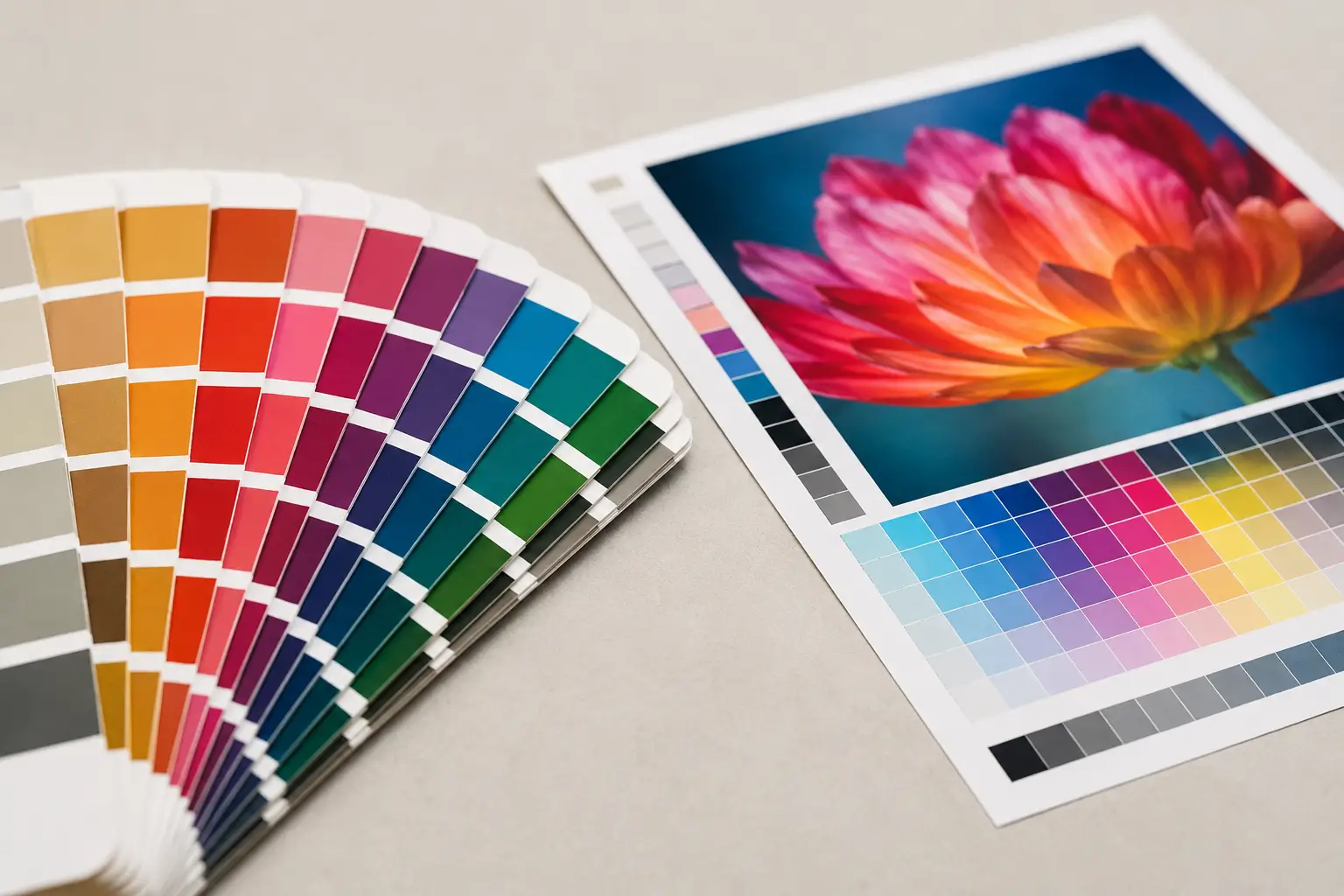
Spot color (PMS) for jobs with fewer than 6 colors, or any time color accuracy matters more than photographic detail. CMYK process for full-color photography, gradients, or when budget rules out spot inks. Most apparel and sign jobs are PMS. Most marketing collateral is CMYK.
Not sure which your file needs? We spec the exact color before it prints.
Send your artwork and a human sets it up in the right mode — named PMS spot colors or a clean CMYK build — production-correct in 24 hours.
Need something custom? Email hello@vectorwiz.com
Why spot color exists
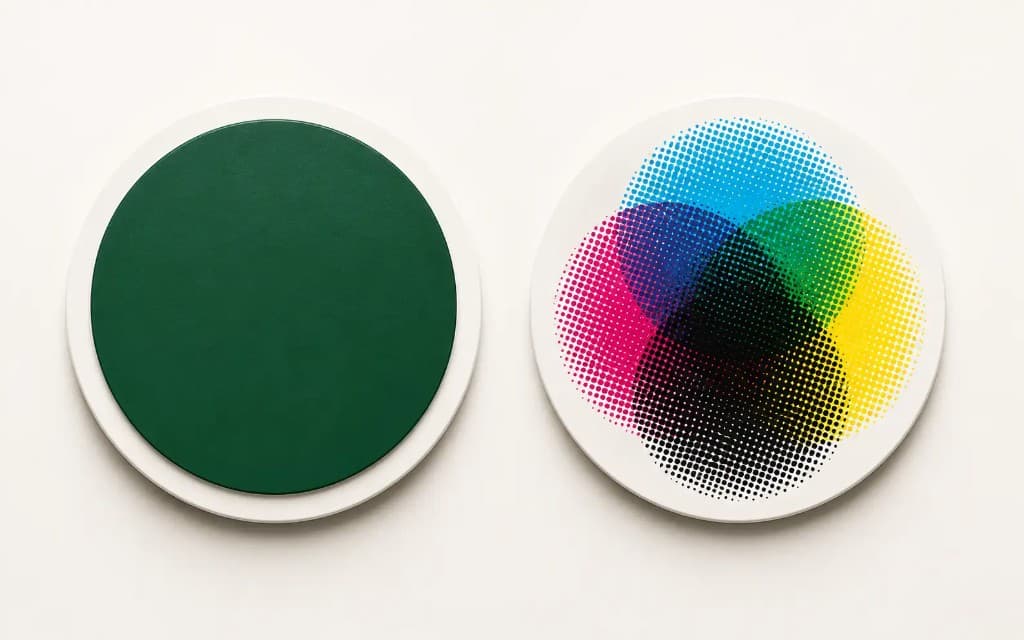
A PMS spot color is a pre-mixed ink — Pantone 354 C is one specific recipe of pigments that produces one specific green. Your press operator pulls the can off the shelf and prints with it directly. The color you see is the color that prints, every time, on every substrate.
Why CMYK exists
CMYK process builds simulate colors by overlaying tiny dots of cyan, magenta, yellow, and black. A "green" becomes a halftone pattern that fools the eye. You can reproduce thousands of colors with just four inks, but every color is an approximation — and the approximation changes with substrate, press condition, and humidity.
When PMS wins
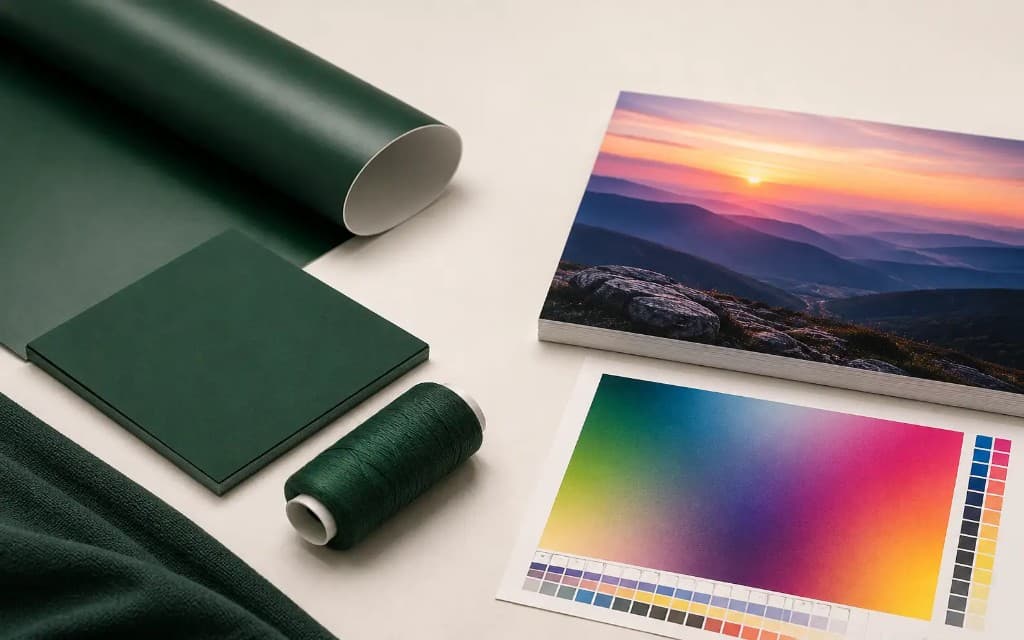
Tight brand colors. Logos with flat color fields. Embroidery (one thread per color). Vinyl. Anything where the same logo gets printed on a hundred different items and needs to match across all of them. PMS gives you reproducibility; CMYK gives you variability.
When CMYK wins
Photography. Gradients. Posters with 50+ colors. Anything where you would need 8+ spot inks to reproduce — at which point CMYK is cheaper, faster, and only marginally less accurate. CMYK also wins when you do not control the press: most digital and web-to-print services run CMYK only.
What we do at VectorWiz
We default to PMS Solid Coated for sign shop, screen-print, and embroidery jobs. We default to CMYK process for general illustration and digital-print work. Either way, we ask at order time — and we call out the exact spec on every layer. See screen printing →
Frequently asked questions
What is the difference between PMS and CMYK?
PMS (Pantone) colors are pre-mixed, named inks — one ink lays down the exact color. CMYK is four-color process, building colors from overlapping cyan, magenta, yellow, and black. Spot color gives exact, repeatable brand color; process gives photographic range.
Which one does my shop need?
Spot color for solid, brand-critical color and limited palettes — logos, signage, single-color decals. Process for photographic or heavily blended artwork. Plenty of jobs use both: process for the imagery plus a spot ink for the brand mark.
How do I hit an exact brand color?
Name it. Define the color as a spot or Pantone value in the file so the printer's color management has one unambiguous target, then confirm with a proof on the actual substrate. A color left as an ambiguous on-screen value is interpreted differently by every workflow.
Should print files be RGB?
No. RGB is a screen model and has no fixed print target. Deliver print artwork with brand colors defined as named spot intent and let the RIP handle the conversion for its press, ink set, and media.
Does the substrate change how a color prints?
Yes, significantly. The same ink reads differently on coated paper, on coroplast, and on cast vinyl under a laminate. For anything color-critical, proof on the real material rather than trusting a screen or a proof on a different stock.
Naimur Rahman
Leads design direction and quality at VectorWiz. Reviews and redraws production artwork by hand across sign, screen-print, embroidery, and CNC work.
Related articles
Drawn by hand. Built for production.
Instant pricing, no commitment. Production-correct vectors in your inbox in 24.