A short history of vector graphics Vector graphics didn’t start with Illustrator.
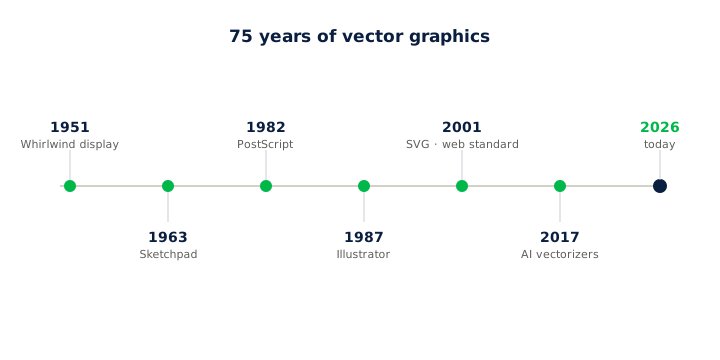
Vector graphics began in 1951 with MIT’s Whirlwind oscilloscope display, became a serious medium in the 1960s with Sketchpad and SAGE, and reached commercial software in the 1980s through Adobe Illustrator (1987), CorelDRAW (1989), and PostScript. The 2000s brought SVG as a web standard. The 2020s introduced AI-trained vectorization (Vectorizer.AI, vector.ai) and collaborative tools like Figma. Production-buyer use cases — sign-shop vinyl, embroidery digitizing, CNC routing — have driven the format ecosystem the whole way.


Before computers (1830s–1940s)
Vector graphics are mathematical descriptions of shapes — paths, points, curves — rather than grids of pixels. The conceptual lineage is older than computing. Mechanical drafting (architectural blueprints, engineering schematics) is vector graphics produced by hand: every line is a path with a start point, an end point, and properties. The earliest commercial drafting tables, French curves, and ruling pens from the 1830s onward are the analog ancestors of every vector graphics tool.
Pantograph machines (used to copy and scale drawings since the 17th century) are vector graphics scaled by mechanical linkage. The conceptual model — describe the shape, then trace the description — is intact.
Early computing (1951–1960s)
The first computer to render vector graphics was MIT’s Whirlwind I in 1951, using a CRT oscilloscope to display point-and-line drawings under program control. Vector CRTs (also called 'random-scan’ displays) drew shapes by deflecting an electron beam directly along the lines — no raster grid, no pixels.
Ivan Sutherland’s Sketchpad (1963), often credited as the first interactive graphics program, used vector display + light-pen input on a TX-2 computer. Sketchpad let users draw and manipulate geometric shapes — points, lines, arcs — establishing the interaction model every vector editor since has inherited.
Through the 1960s, vector displays dominated CAD and military use (SAGE, the air-defense system, was a major customer). Raster displays existed but couldn’t match the precision of vector for engineering work at the resolution of the day.
The rise of raster (1970s)
Raster displays — pixel grids on CRTs — became viable in the 1970s as memory got cheaper. The Xerox Alto (1973), the first computer with a bitmapped display, made raster the future of interactive computing. By the late 1970s, raster had won for general-purpose displays.
But vector graphics survived in specialized domains: drafting, typography, plotting. The HP-GL (Hewlett-Packard Graphics Language, 1977) standardized vector commands for plotters — a format still in use today for some industrial cutters and pen plotters.
PostScript and the desktop publishing revolution (1980s)
PostScript, invented at Adobe by John Warnock and Charles Geschke in 1982 (released 1984), was the breakthrough that brought vector graphics to mainstream printing. PostScript describes a page as a program — paths, fills, strokes, fonts — interpreted by the output device. Apple LaserWriter (1985) was the first PostScript printer, and the Apple Mac + LaserWriter + Aldus PageMaker combination launched desktop publishing.
On the editing side, Adobe Illustrator 1.0 launched in 1987 — vector drawing with Bézier curves, accessible to anyone with a Mac. CorelDRAW shipped for Windows in 1989. Macromedia FreeHand became the third major player. These three formats — AI, CDR, and FH — defined commercial vector graphics for the next twenty years.
Format proliferation (1990s)
The 1990s saw vector formats spread into specialized industries. EPS (Encapsulated PostScript) became the de-facto print-production format. DXF (AutoCAD’s drawing exchange format, originally 1982) became the CNC and laser-cutter lingua franca. Flash’s SWF (1996) introduced vector animation for the web. PDF (1993, vector-native) replaced PostScript as the document exchange standard.
On the production side, vinyl plotters (Roland, Gerber, Graphtec) standardized on vector input — a sign shop in 1995 was already running cut paths from Illustrator or CorelDRAW into a Roland plotter. Most of the production-buyer workflows VectorWiz serves today existed in their current form by 1995.
SVG and the modern web (2000s)
SVG (Scalable Vector Graphics) was finalized as a W3C standard in 2001. Built on XML, it positioned itself as the open-standard vector format for the web — competing with Adobe’s SWF (Flash) and Adobe’s own SVG-killer attempt PGML. Adoption was slow until browser support matured around 2010.
Once SVG became universal in browsers, the format unlocked a new generation of design tools (Figma, Sketch) and developer workflows (CSS-styled icons, animation libraries, inline component design). Today, the SVG format underlies most of the icon systems on the web — Heroicons, Lucide, Material Icons, Phosphor — and most app design (Figma exports to SVG).
The modern era (2010s–2020s)
| Year | Milestone |
|---|---|
| 2012 | Sketch ships on Mac, popularizes SVG-first interface design. |
| 2013 | Adobe announces Creative Cloud, moves Illustrator to subscription. |
| 2015 | Affinity Designer launches as a one-time-purchase alternative. |
| 2016 | Figma reaches GA — collaborative vector design in the browser. |
| 2018 | Linearicons, Heroicons, and the 'everything is an SVG’ icon system era. |
| 2022 | Vectorizer.AI and vector.ai launch, AI-trained raster-to-vector conversion. |
| 2023 | Adobe Firefly Vector adds AI vectorization to Creative Cloud. |
| 2024 | Recraft ships AI-generated vector graphics from text prompts. |
| 2026 | Production-buyer SaaS platforms (like VectorWiz) consolidate the conversion workflow for sign shops, embroidery, screen print, signage, engraving. |
History aside, you probably have a file that needs vectoring today.
Drop it into our free tracer to see where auto-trace breaks — then a human redraws it production-correct in 24 hours.
Need something custom? Email hello@vectorwiz.com
Why this history matters for production buyers
Most production-buyer file headaches stem from format-era mismatches. A sign-shop’s plotter wants HP-GL or DXF from 1980s production tooling. An embroidery digitizer wants stitch-friendly geometry rooted in 1970s automated-loom commands. A screen press wants halftone-angled positives from offset-printing standards. The vector ecosystem accumulated these formats over 75 years, and they all still matter.
The job of a modern vector conversion service is bridging the historical formats. When VectorWiz converts a customer-supplied PNG into AI + EPS + DXF + PDF, we’re translating across half a century of vector graphics. The mathematical foundation is Bézier’s 1962 work; the format ecosystem is the accumulated weight of every industry that adopted vector graphics along the way.
Frequently asked questions
When were vector graphics invented?
The conceptual model predates computers — mechanical drafting and pantograph machines are vector graphics in analog form, dating to the 1830s. The first computer vector graphics ran on MIT’s Whirlwind I in 1951, using a CRT oscilloscope. Ivan Sutherland’s Sketchpad (1963) is widely credited as the first interactive vector graphics program.
What was the first vector graphics software?
Sketchpad (1963), built by Ivan Sutherland at MIT, is the canonical answer. It ran on a TX-2 computer with a vector display and light-pen input. The first commercial vector graphics software was Adobe Illustrator 1.0 in 1987.
What’s the difference between vector and raster?
Vector graphics describe shapes mathematically (paths, points, curves) — infinitely scalable, small file sizes, sharp at any zoom. Raster graphics are grids of pixels — fixed resolution, larger files, blur when enlarged. Vector is for logos, icons, and production output; raster is for photos and painterly art.
Why is PostScript important?
PostScript (1982, Adobe) was the format that made desktop publishing possible. It describes a page as a vector program interpreted by the output device, regardless of resolution. Apple LaserWriter (1985) + Apple Mac + Aldus PageMaker (1985) on PostScript launched the desktop publishing era. Modern PDF is a direct descendant of PostScript.
When did SVG become a web standard?
SVG was finalized by the W3C in September 2001. Browser support was patchy until 2010 (Internet Explorer 9 added support); from there it became universal. Today, SVG underlies most icon systems on the web and most interface-design tool exports (Figma, Sketch).
Are Bézier curves named after someone?
Yes — Pierre Bézier, a French engineer at Renault who published the curve math in 1962 for car-body design. Paul de Casteljau independently derived the same math at Citroën in 1959, but Renault published first. Bézier curves are how every modern vector graphics tool describes smooth shapes.
What replaced Flash for vector graphics on the web?
SVG. Flash (Macromedia, later Adobe) dominated web vector animation from 1996–2010. Apple’s 2010 decision to not support Flash on iOS, plus accumulating security issues, pushed the web toward SVG + CSS + JavaScript. Adobe officially ended Flash support in December 2020.
Will AI replace traditional vector tools like Illustrator?
Unlikely fully. AI tools (Vectorizer.AI, vector.ai, Firefly Vector, Recraft) are excellent for stylization and one-shot conversion, but production-grade work — color separation, font outlining, kerf-compensated paths, halftone seps — still requires human judgment. AI is now a step in the workflow, not a replacement for the workflow.
Naimur Rahman
Leads design direction and quality at VectorWiz. Reviews and redraws production artwork by hand across sign, screen-print, embroidery, and CNC work.
Related articles
Drawn by hand. Built for production.
Hand-redrawn from $19, back in 24 hours. Upload for an instant price, no commitment.