How Screen Printing Shops Can Price Vector Cleanup Without Losing Profit

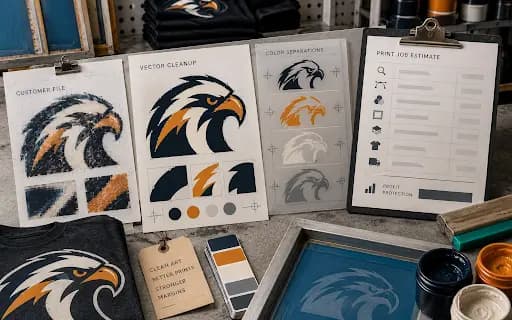
A customer walks in with a phone photo of a trucker hat, tells you they want that exact logo on fifty shirts, and your art department quietly groans. That flattened, low resolution image needs a full redraw before it can go anywhere near a screen, and whatever flat art fee you have charged for years was never built with this particular job in mind. Vector cleanup pricing for screen printing shops comes down to one habit, letting the actual work set the number instead of a fee you settled on years ago and never revisited. At VectorWiz, where a team of former shop artists handles this exact problem for print shops all day, every upload gets looked at before it gets a price.
Why Does a Flat Art Fee Lose Money on Screen Printing Jobs?
Most shops charge one flat number for art prep because it is simple at the counter, and most artwork prep pricing gets built around whatever job feels typical rather than what a specific file needs. A solid color wordmark and a six color vintage badge with halftone shading are not the same job, and treating screen printing art department fees as one flat line means one job is overpriced while the other quietly bleeds you dry. A clean vector logo a customer already owns might take five minutes to check. A blurry photo of a mascot with gradient shading can eat an hour, and if your fee was built around the easy job, the hard one is where your profit disappears without anyone noticing.
What Actually Decides How Much a Vector Cleanup Job Should Cost?
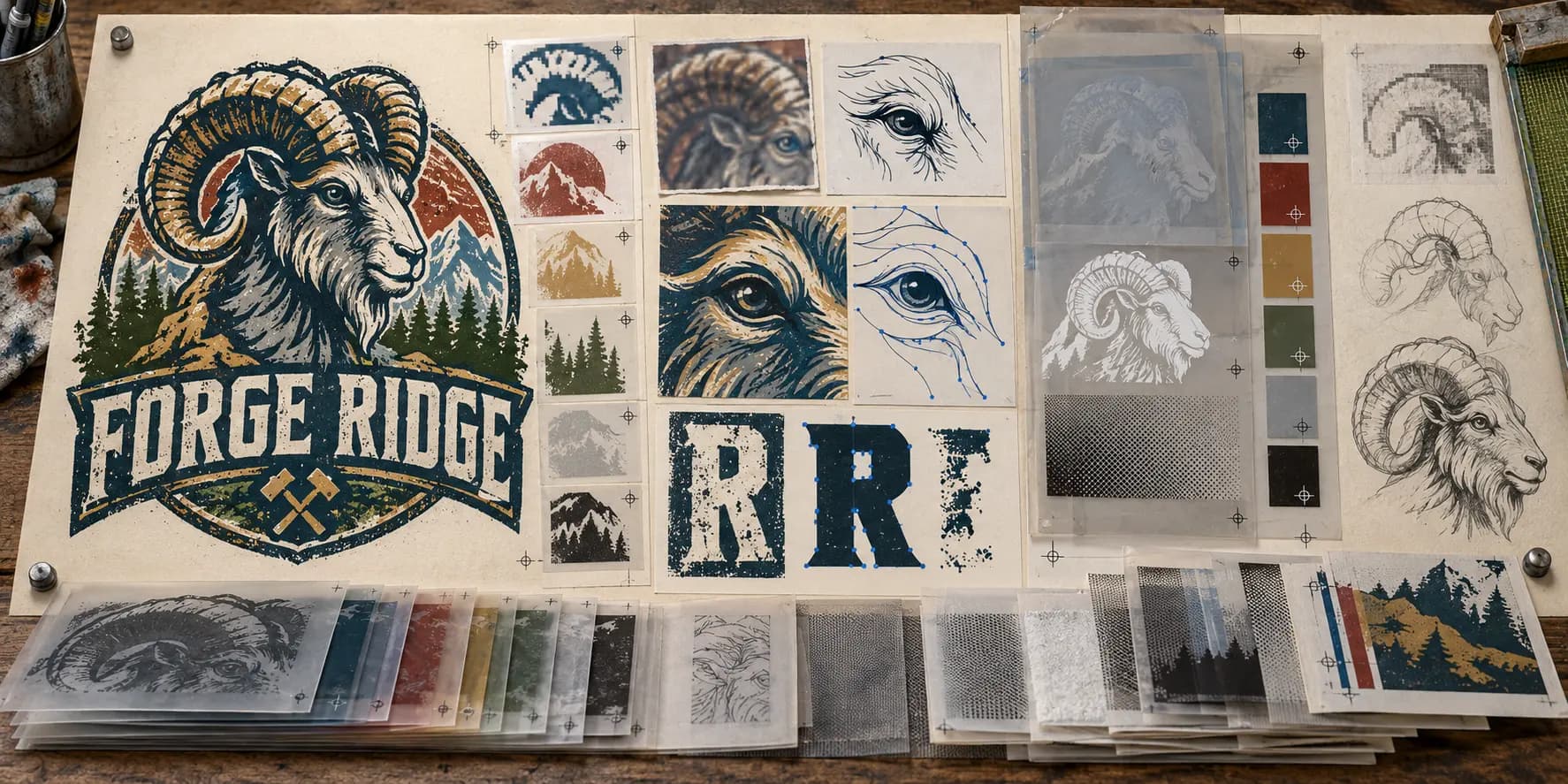
Price should follow the work, not the file. Color count comes first, since one color and six color separations are simply different amounts of labor. Source quality matters just as much, a crisp high resolution file pulls a job toward the cheap end while a torn scan or grainy photo pushes it toward the expensive end, since the designer has to reconstruct detail rather than trace it. Geometric complexity plays in too, fine mascot fur or ornate script takes longer to draw clean than a basic mark. Type treatment matters on its own, standard fonts are quick while custom hand lettering or distressed type has to be redrawn stroke by stroke. Workflow specificity adds another layer, a plain vector file is one thing, but a job needing full spot color separation cost work, underbase prep, or halftone setup for a specific press is genuinely more labor. And whether the source can be redrawn or has to be reillustrated from a rough reference changes the whole scope of the job.
Should You Charge a Flat Fee or a Tiered Fee When Pricing Vector Cleanup?
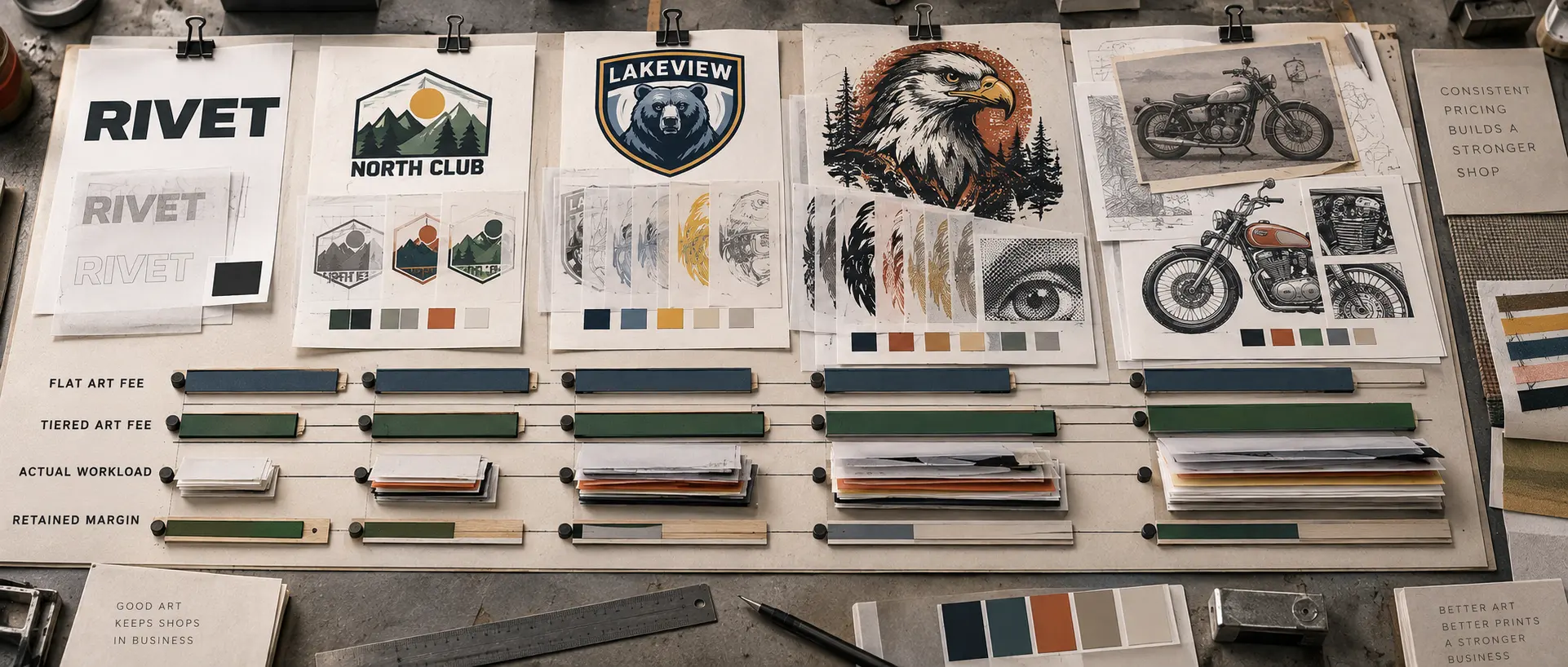
Jobs vary this much, so a tiered structure protects your margin far better than one flat number ever will. Here is how the two approaches actually play out on real jobs.
| Flat Art Fee | Tiered Art Fee | |
|---|---|---|
| Simple logo, clean source | Overpriced for the customer | Priced fairly, quick turnaround |
| Six color mascot from a photo | Underpriced, shop absorbs the loss | Priced to match the actual labor |
| Customer trust | Feels arbitrary once jobs are compared | Easy to justify with a clear reason |
| Shop profit consistency | Swings job to job | Stays predictable across a full week |
| Time to quote | Fast but inaccurate | Takes a quick look, but accurate |
A tiered system takes a minute longer at the counter because someone has to actually look at the art before quoting it, and that tradeoff is worth naming honestly rather than pretending tiered pricing is free. What it buys back is margin, since a tiered structure stops the six color mascot job from silently subsidizing itself out of your profit the way a flat fee always does.
How Do You Explain a Tiered Price to a Customer Without Losing Their Trust?
The moment a customer notices two friends paid different art fees, the questions start, and the answer that holds up is showing them why rather than just stating the number. Pull up the source file next to a clean example and point at what actually changed, the color count, the missing separations, the fact that a photo has to be redrawn while a vector file just needs checking. Keeping the same tier boundaries every time, rather than adjusting them by customer or by mood, is what makes the system feel fair instead of arbitrary once regulars start comparing notes. If a customer pushes for a discount on a job that is genuinely a higher tier, holding the line matters more than it seems, since one quiet exception becomes the price every customer after them expects.
Do Reorders and Rush Jobs Need a New Art Fee?
Not automatically. Once a design has been vectorized and approved, running it again for a reorder is a production decision, not a new art job, so charging the art fee twice on an unchanged file is one of the fastest ways to lose a repeat customer's trust. A new art charge only belongs on a reorder if the design itself changes, a new colorway, added text, a different placement that needs a fresh separation. Rush requests are a separate lever entirely, since a customer trying to jump the queue is not paying for more color count, they are paying to skip ahead of everyone else, so a percentage based rush surcharge on top of the normal art fee tends to hold up better than trying to fold urgency into the base price itself.
How Does VectorWiz Set Its Own Tiers Without Guessing?
At VectorWiz, a designer runs every upload through the six factors above and lands on one of four tiers before any billable work starts. The tier and price get locked within two business hours of upload, and if a job creeps in scope once work is underway, that becomes a new quote rather than a surprise line item.
Tier 1, $19
Simple single color work with clean source art, a solid wordmark or a basic monogram, most of which turns around in under six hours.
Tier 2, $57
Moderate multi color work, three to five colors with basic gradients, the range a sports team logo or a four color sign panel usually falls into.
Tier 3, $114
Intricate detail or six or more colors, a shaded mascot or a vintage badge with several separations to keep track of.
Tier 4, $190
Full reillustration, where the source is really just a reference and the designer is drawing from scratch, the tier that covers complex stitch maps or mural prep.
What About Jobs That Fall Between Two Tiers?
Not every job lands cleanly. A logo with four colors and slightly rough art might sit between a Tier 1 and Tier 2 job, and the honest move is to round to the nearest tier rather than inventing a Tier 1.5 nobody can explain later. When a job is on the bubble, rounding down toward the customer is usually right, since a shop that nickel and dimes borderline jobs trains customers to distrust every quote that follows. This occasionally means eating a few extra minutes of labor, which is simply part of running a fair pricing system.
Does Outsourcing Vector Cleanup Actually Change the Math?
Outsourcing artwork cleanup changes the math more than most shops expect, especially on the weeks when press time matters more than art time. Sending files to VectorWiz means the tier and price are set before anyone touches the job, so the shop can quote a firm number immediately instead of waiting on an artist to get to it between press runs. Standard turnaround runs twenty four hours, rush is twelve hours for a fifty percent surcharge, and flex is three business days for a ten percent discount. Delivery includes layered source files plus print ready vector files, typically AI, SVG, and PDF, with EPS, DXF, or platform specific formats available at no extra charge, and there are no setup fees either way.
Revisions are included until the file is right, and if a delivered file is not production-correct, VectorWiz remakes it free. Shops running steady volume can also skip the per job pricing altogether and move to a credit based plan, where a Tier 1 job costs 5 credits, a Tier 2 costs 15, a Tier 3 costs 30, and a Tier 4 costs 50. The Starter plan runs $399 a month for 130 credits with rollover up to 390, and the Pro plan runs $799 a month for 380 credits with rollover up to 1,140 and a dedicated account designer.
A shop only sending in the occasional tricky job is usually better off staying per job, but once a shop is regularly burning more than roughly 130 credits worth of cleanup work a month, which most subscribers land around 12 to 18 credits per job, a subscription starts working out cheaper than paying tier by tier. It is also worth knowing that a design headed for both a screen and an embroidery machine is not one job, it is two, since the file prep for spot color separations and the file prep for a stitch map are different disciplines with their own tier and price.
Ready to Price Cleanup Work Without the Guesswork?
The shops that protect their margin are the ones that stop charging every job the same, whether that means building tiers in house or handing the variability to a team that already prices it that way. If a job is sitting in the queue right now, uploading it at vectorwiz.com gives a tiered quote within two business hours, locked before any work begins. For shops running enough volume to want one predictable monthly number instead of per job pricing, a credit plan does the same job at scale. Either way, email hello@vectorwiz.com for a bulk batch or a custom quote.
Frequently asked questions
What should vector cleanup cost on a screen printing job?
It depends heavily on the actual job, and using one flat number for every design is where most shops lose money. VectorWiz's own tiered pricing runs from $19 for a simple single color logo up to $190 for a full reillustration, and that range is a useful reference point whether a shop is building its own in house tiers or comparing them against the cost of outsourcing.
What makes a cleanup job more expensive?
Color count, source quality, geometric complexity, custom type, and whether the file needs full separations or a stitch map all push a job toward a higher price. A blurry photo as source art is one of the biggest cost drivers.
Is it cheaper to keep vector cleanup in house or outsource it?
It depends on your volume and how busy your art department already is. Outsourcing gives a fixed, upfront price, while in house control can make sense with steady art volume.
How long does a vector cleanup job usually take?
A simple job can turn around in under six hours, while a complex illustration or full separation job can take up to a day or more.
What file formats should be requested after cleanup?
Ask for layered source files plus at least one print ready vector file like AI, SVG, or PDF, and request DXF or a specific software format if the shop uses Wilcom or GraphTec.
Should every customer be charged the same art fee?
No. A flat fee across every job type is where most shops quietly lose money, since a simple wordmark and a photo based mascot redraw take very different labor.
What happens if a vectorized file comes back wrong?
A reputable service should remake it free rather than offering store credit, since a wrong file is not something a shop can bill a customer for as is.
Naimur Rahman
Leads design direction and quality at VectorWiz. Reviews and redraws production artwork by hand across sign, screen-print, embroidery, and CNC work.
Related articles
Drawn by hand. Built for production.
Instant pricing, no commitment. Production-correct vectors in your inbox in 24.