Vehicle wrap bleed chart: how much per panel.
Bleed is artwork extended past a panel's trim line so alignment drift never leaves unprinted substrate showing; seam overlap is the shared art where two panels meet. A common baseline is about half an inch of bleed on flat panels and more on compound curves like bumpers and mirrors, with roughly half an inch to an inch of seam overlap. Exact numbers come from your printer's vehicle template — the chart below is a typical starting point, not a universal standard.

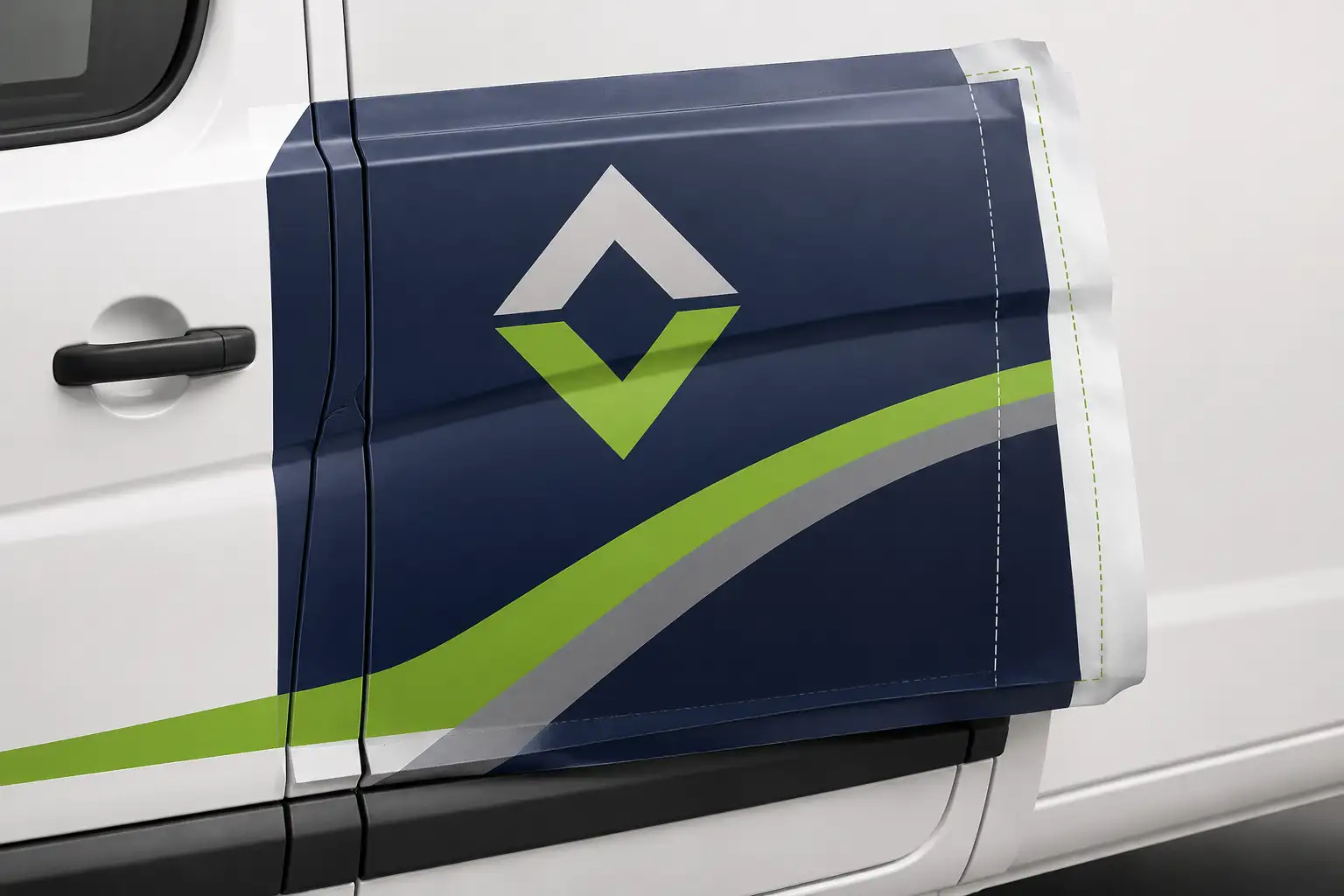
Two numbers decide whether a wrap panel installs clean: how far the art bleeds past the trim, and how much it overlaps at a seam. Both come from your printer's vehicle template — but shops ask us for a ballpark constantly, so here is a typical chart with the reasoning behind each row.
Send your template. We lay the art in with bleed and overlap built.
Full-scale panels, seam overlap, and contour-cut layers set to your printer's vehicle template — RIP-ready in 24 hours.
Need something custom? Email hello@vectorwiz.com
Typical bleed and overlap by panel
| Panel / element | Typical bleed past trim | Seam overlap | Why |
|---|---|---|---|
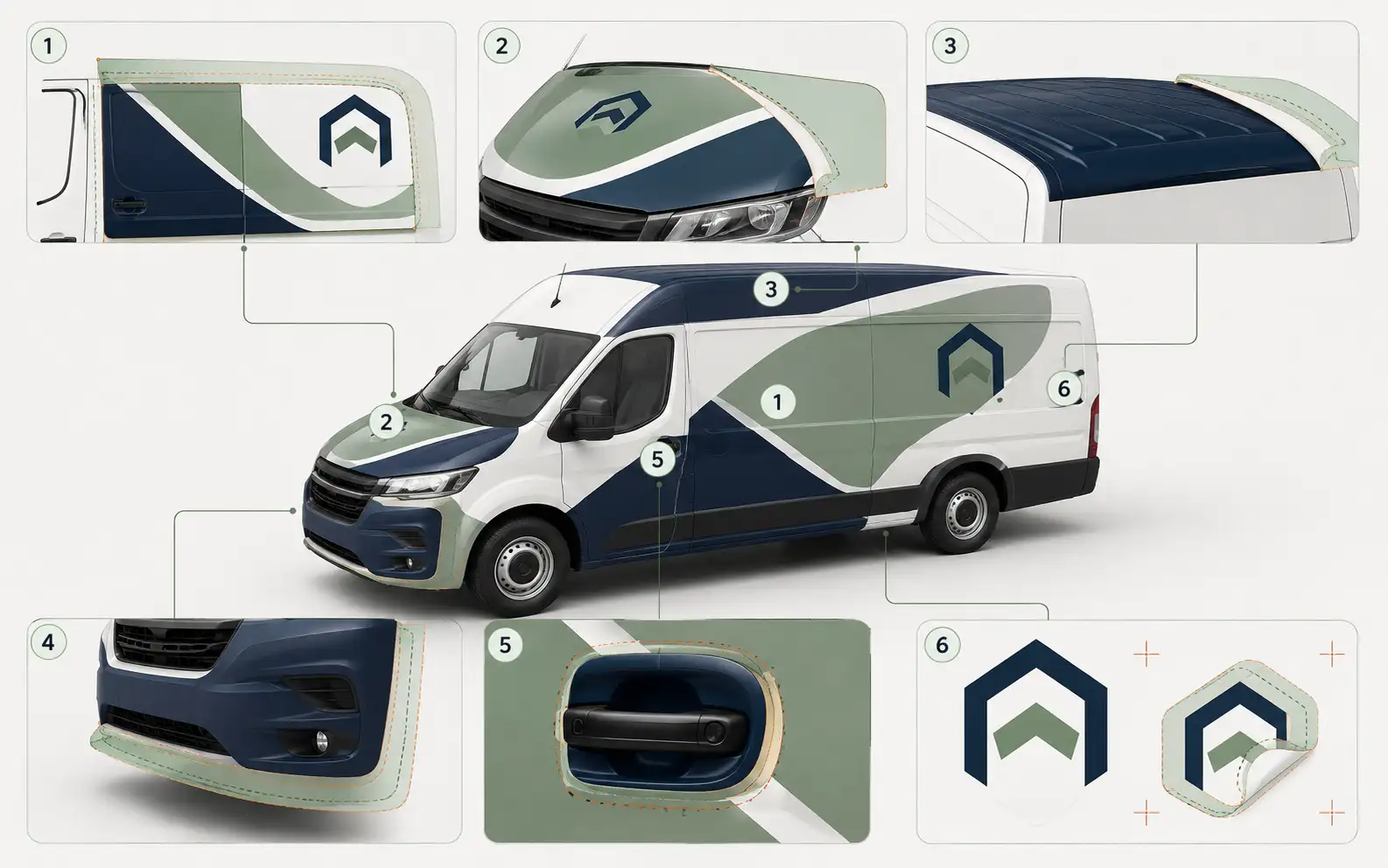
| Body side panels (flat) | 0.5" (~12mm) | 0.5"–1" | Flat, predictable; baseline bleed is enough |
| Hood | 0.5"–1" | 0.5"–1" | Large flat area with edges that wrap under the lip |
| Roof | 0.5"–1" | 0.5"–1" | Wraps over gutters and edges; give the installer material |
| Bumpers | 1"+ | n/a | Compound curves stretch and tuck — needs extra material |
| Mirrors, handles, recesses | 1"+ | n/a | Deep curves and cutouts consume film during conforming |
| Window perf | 0.5" | n/a | Prints to the perf sheet edge; align to the glass opening |
| Partial wrap / cut decal | 0.125"–0.25" past the cut | n/a | Print bleeds past the contour path so no white edge shows |
Why bleed exists at all
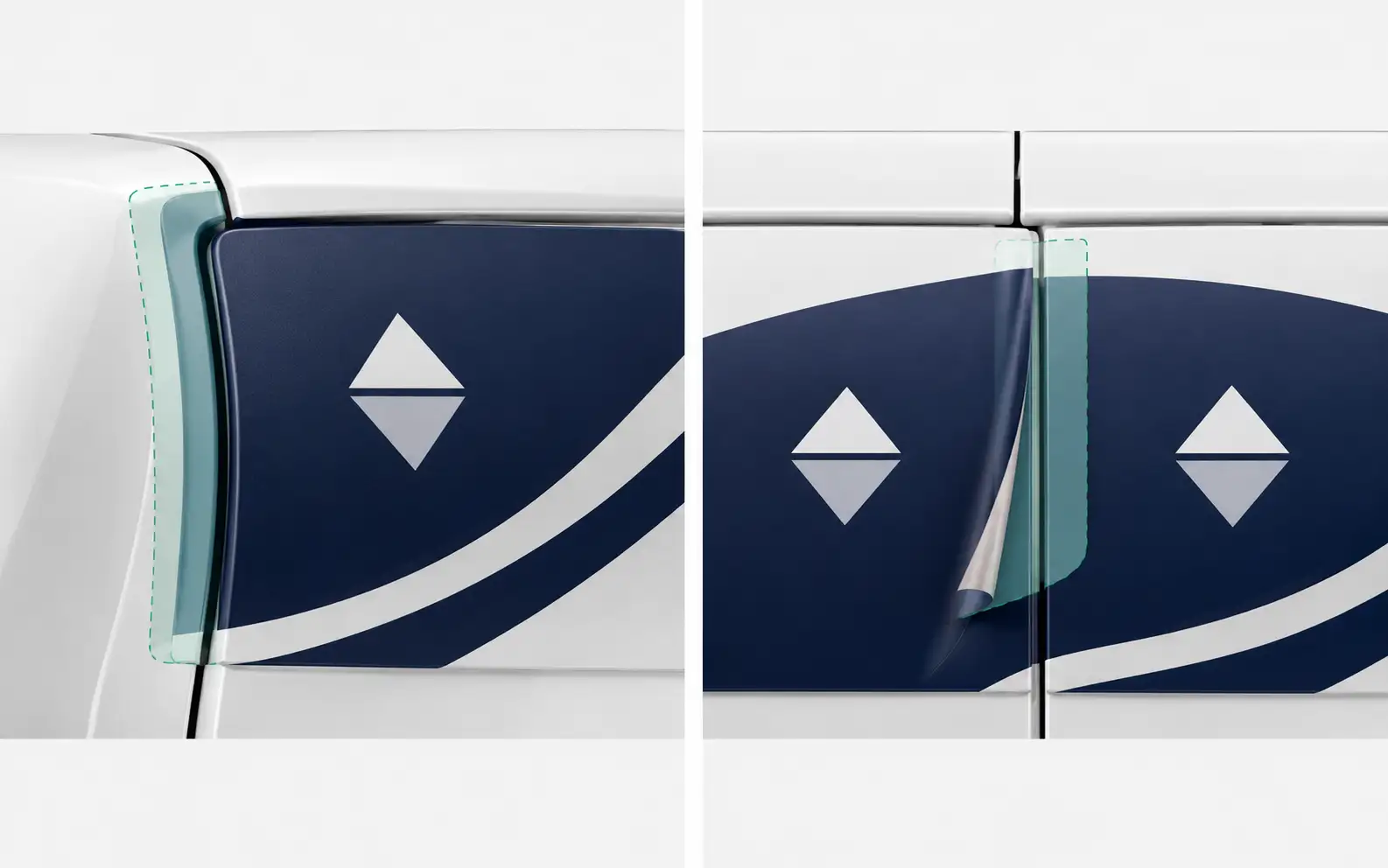
No install is pixel-perfect. Panels shift a hair as the installer squeegees and heats the film. Bleed is the safety margin: if the art runs past the trim line, that drift eats into the bleed instead of exposing bare substrate at the edge. Build art to the exact edge and any movement shows as an unprinted line.
Why compound curves need more
A flat door panel behaves. A bumper, a mirror cap, or a deep body recess does not — the vinyl is stretched and tucked to conform, and that consumes material. Panels covering those areas carry more bleed so the installer still has printed film to work with after the vinyl is conformed, rather than running out at the very edge of the curve.
Print bleed vs contour cut on decals
For print-cut decals and partials, two things happen: the print bleeds a little past the cut line, and a contour path cuts the finished shape. The bleed keeps a registration drift from showing a white halo; the cut path itself stays exact. Those live on separate named layers — see the wrap art guidelines for how the cut layer should be set up.
How to read your printer's template
Most large-format wrap printers publish per-vehicle templates that already mark the trim line, the bleed area, and the seam positions. Lay your art into that template at full scale, extend every edge into the marked bleed, and carry the graphics across the marked seams. When you send us the template with your order, we set all of that up so it matches exactly what the printer expects.
Frequently asked questions
How much bleed does a vehicle wrap need?
A common baseline is about half an inch (roughly 12mm) of bleed past the trim line, with more on compound curves like bumpers and mirrors. Your printer's vehicle template is the authority — the ranges below are typical starting points, not a universal spec.
What is seam overlap on a wrap?
Where two printed panels meet, the art overlaps so color and graphics carry continuously across the joint with no substrate showing. Overlap is usually around half an inch to an inch, again set by the printer's template and how the installer laps the panels.
Why do bumpers and mirrors need more bleed?
Compound-curved areas get stretched and tucked during install, so they consume more material than a flat panel. Extra bleed on those pieces means the installer still has printed film to work with after conforming the vinyl.
Does the contour-cut line get bleed too?
Print-cut decals bleed past the cut path so a slight registration drift never shows a white edge, then the contour path cuts to the finished shape. The cut path itself is exact; the print underneath extends past it.
Can VectorWiz set up bleed for my template?
Yes. Send your printer's vehicle template (or the make, model, and year) and we lay the art into it at full scale with bleed and seam overlap where you need it — delivered RIP-ready, standard in 24 hours.
Naimur Rahman
Leads design direction and quality at VectorWiz. Reviews and redraws production artwork by hand across sign, wrap, screen-print, and CNC work.
Related articles
Drawn by hand. Built for production.
Instant pricing, no commitment. Production-correct wrap art in your inbox in 24.